6 Steps of ERP Deployment
Key Phases in a Successful ERP Implementation Plan
 Contact AVT
ERP Overview
Enterprise resources planning (ERP) solutions support an organisation in almost each perspective of commerce operations by centralising data and through automation. These integrated management of main business processes, often in real time and mediated by software and technology, facilitating the business planning of financials, customers, vendors, materials, goods, services and employees.
The central feature of all ERP systems is a shared database that supports multiple functions used by different business units. In practice, deploying an ERP means that employees in different departments, such as accounting and sales and human resources, can rely on the same information for their business process needs.
Summary of ERP implementation process
Each ERP usage is somewhat diverse with no standard layout, but in general, the execution prepare has centre likenesses in each occasion. At a high level, an ERP implementation involves implementing improved processes across various departments and roles and transferring financial and transactional data for each department, user group or business role.
1. ERP implementation stages Overview
The strategy of an ERP usage can be broadly divided into basic and advanced implementation where basic implementation includes deploying the out of the box processes delivered with the ERP software, whereas the advanced implementation includes more complex automations to meet current business automation needs.
The project is defined into 5-6 phases and the success of each phase is crucial to the completion of the project.
ERP Project Engagement consists of the following phases:
Analyse: Discover Map business requirements and Plan Deployment Strategy
Configure: Train and setup ERP to configure Process flows and data integration
Deploy: Get the system and users ready for Go Live
Optimise: Analyse, Plan and Deploy Improvements to meet future needs
The only ERP you’ll ever need
2. ERP implementation engagement models Shared vs Guided?
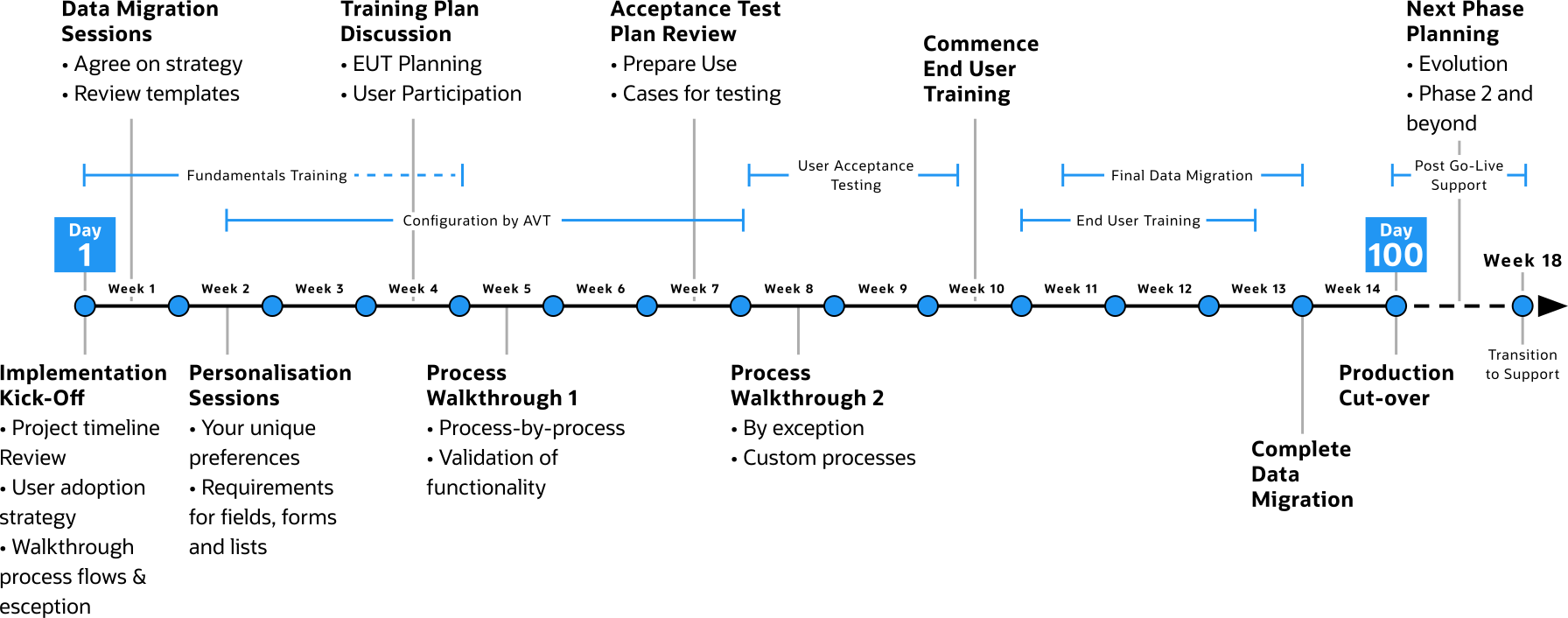
Understand Shared and Guided Implementation and Go Live in 100 Days
[mk_icon_box2 icon_size=”64″ icon=”mk-icon-refresh” icon_color=”#2196f3″ title_top_padding=”0″ title_bottom_padding=”0″][/mk_icon_box2]AVT provides the implementation using the Shared and Guided Implementation delivery models. In a Shared Implementation, the implementation work estimated and is shared between client and AVT resources. The project is estimated in phases and project plan is drafted and tracked through the lifecycle of the implementation. AVT used train the trainer approach to drive the delivery of the configurational aspects of the implementation.
[mk_icon_box2 icon_size=”64″ icon=”mk-icon-flag” icon_color=”#2196f3″ title_top_padding=”0″ title_bottom_padding=”0″][/mk_icon_box2]In a Guided implementation, the client resources execute most of the work. The client is trained and guided through the implementation and AVT is provides assistance as needed in the capacity of the trainer. In a Guided Implementation, the client takes greater responsibility in configuring the system and meeting project timelines. Guided implementations tend have a less cash outlay than Shared implementations however may take longer as complete as the resources is limited to client resources and the resources need to overcome the learning curve related to the the new system.
3. Training Different types of Users
Training users is a key part of the implementation methodology and as your enablement process. Deploying a new ERP is a huge learning curve for an organisation that can take months to years. The implementation staff will perform a number of training sessions to help with the successful deployment of business systems within your organisation. It’s important to get the best results out of the training.
ERP Project Engagement training methodologies:
• Orientation Training Before the implementation progresses further, your staff will be taken through an Orientation training so they can understand key aspects of the system and terms
• Power User Training: Your key users will be trained on the out-of-the box systems aspects and processes including NetSuite Administration, Sales & CRM, Marketing Automation, Finance, AP, AR, Inventory and Warehousing, Data Importing and Reporting
• End User Training: You may wish to engage Service Providers in performing End User Training. Typically once the Power Users are trained and enabled they are able to perform the “End User” training themselves
NetSuite – The #1 Cloud Business Management System: The only ERP you’ll ever need
4. Defining scope and requirements
Due the change and the number of stakeholders involved as various departments, ite very important to make sure that there is a clear understanding and alignment between departments, roles and responsibilities. It’s often hard to document each procedure in text and tables as it can be quite substantial.
4.1 Change of Scope Management
Understand Shared and Guided Implementation and Go Live in 100 Days
In the event that the Customer and Solution provider requests a Change in any of the specifications, requirements, or scope. The party seeking the change should document the change and each party’s Project Leads should meet to discuss the proposed changes (“Change Meeting”).
The parties must mutually agree on any such changes and the changes shall be documented, in writing, and signed by both parties. In some cases, a Change Request for additional funding may be required. In the event that the parties disagree about the proposed changes to the general scope, the parties shall identify a senior manager who has decision-making authority for each of the respective parties.
The managers shall confer and work to reach a mutually agreeable conclusion that shall be documented, in writing, and signed by both parties. This forms the basis for change control management.
NetSuite – The #1 Cloud Business Management System: The only ERP you’ll ever need
5. Data Migration
ERP Project Engagement training methodologies:
This part of the project will be carried out in accordance with the data extraction and migration strategy. You will typically need functional and technical resources for data extraction assistance and provide templates for each data type to be migrated, and will advise the Customer on best practices for data consolidation and data planning.
Client has the ultimate responsibility in approving data changes, consolidation, cleansing and making data import decisions.
NetSuite – The #1 Cloud Business Management System: The only ERP you’ll ever need
6. Project Management and Go Live Transition
Due the change and the number of stakeholders involved as various departments, ite very important to make sure that there is a clear understanding and alignment between departments, roles and responsibilities. It’s often hard to document each procedure in text and tables as it can be quite substantial.
Understand Shared and Guided Implementation and Go Live in 100 Days
In the event that the Customer and Solution provider requests a Change in any of the specifications, requirements, or scope. The party seeking the change should document the change and each party’s Project Leads should meet to discuss the proposed changes (“Change Meeting”).
The parties must mutually agree on any such changes and the changes shall be documented, in writing, and signed by both parties. In some cases, a Change Request for additional funding may be required. In the event that the parties disagree about the proposed changes to the general scope, the parties shall identify a senior manager who has decision-making authority for each of the respective parties.
The managers shall confer and work to reach a mutually agreeable conclusion that shall be documented, in writing, and signed by both parties. This forms the basis for change control management.
NetSuite – The #1 Cloud Business Management System: The only ERP you’ll ever need
AVT NetSuite ERP Implementation Journey
AVT Offers an End-to-End Cloud Business Digital Transformation
Market Leading Integrated cloud business software to run your Business. Ideal for SMB Market for 20-250 Employees. Cross Vertical solution for Distribution, Manufacturing, Service and Software companies looking to streamline and scale business operations using one integrated database and cloud applications for business management. Used by 20,000+ companies globally.
Training
Training users is key part of the implementation methodology and our enablement process. Our implementation staff will peform a number of trainings to help with the successful deployment of business systems within your organisation.
• Orientation Training: Before the implementation progresses further, your staff will be taken through an Orientation training so they can understand key aspects of the system and terms.
• Power User Training: Your key users will be trained on the out-of-the box systems aspects and processes including NetSuite Administration, Sales & CRM, Marketing Automation, Finance, AP, AR, Inventory and Warehousing, Data Importing and Reporting.
• End User Training : You may wish to engage AVT in performing End User Training. Typically the once the Power Users are trained and enabled they are able to perform the “End User” training themselves.
Data Migration
This part of the project will be carried out in accordance with the data extraction and migration strategy. AVT will provide technical resources for data extraction assistance and provide templates for each data type to be migrated, and will advise the Customer on best practices for data consolidation and data planning. AVT will provide functional staff to assist the client. Client has the ultimate responsibility in approving data changes, consolidation, cleansing and making data import decisions.
Scope Management
In the event that the Customer or AVT requests a Change in any of the specifications, requirements, or scope. The party seeking the change shall, by written notice, propose the applicable changes. Each party’s Project Leads shall meet, either in person or via telephone conference, to discuss the proposed changes (“Change Meeting”). The parties must mutually agree on any such changes and the changes shall be documented, in writing, and signed by both parties. In some cases, a Change Request for additional funding may be required. In the event that the parties disagree about the proposed changes to the general scope, the parties shall, within one week from the date of the Change Meeting, identify a senior manager who has decision-making authority for each of the respective parties. The managers shall confer and work to reach a mutually agreeable conclusion that shall be documented, in writing, and signed by both parties.
Go Live and Support
We take pride in providing our customers with expert support for all technical issues relating to NetSuite.
AVT offers Basic, Silver, Gold and Enterprise Support Packages to improve your company needs, no matter at what stage of implementation or company size. There’s always a package to suit your budget.
We have been helping Companies to Manage Successful NetSuite Cloud Based Business Practices and Solutions for more than 15 years, +1000 projects completed, and counting.
Risk and Governance
Every project has its risks. Taking the time to detail these upfront, and to monitor them during the implementation lifecycle will keep them visible, enabling the Client to actively manage them toward a positive outcome. The probability gives the risk context, while the impact is used to plan for the strategy that will neutralise the risk. To find out more details please request additional information from AVT.
Project governance is the management framework within which project decisions are made. Project governance is a critical element of any project since the accountabilities and responsibilities associated with an organisation’s business as usual (BAU) activities are laid down in their organisational governance arrangements. The role of project governance is to provide a decision making framework that is logical, robust and repeatable to govern an organisation’s capital investments. In this way, an organisation will have a structured approach to conducting both its business as usual activities and its business change, or project activities.
Funding
We offer funding the deployment using our financing program with Oracle NetSuite. The pragram is very attractive for our SMEs as they can finance the entire solution over the next 3-5 years. The customers need to go through a credit application assesment before financing is approved.
Why does your company need it?
One System For Your Entire Company
The Cloud Advantages
The Cloud is Having a Measurable Impact on Business
Average improvement in time to market
Average increase in company growth
Average increase in process efficiency
Average reduction in operational costs
Average reduction in IT spending
Average reduction in IT maintenance cost
Responsive, Fast-paced and Quality Deployments
Raising The Bar Of Integration Expertise
Why Talk to AVT about ERP & CRM Implementation?
The ultimate performance of our Business relies on Systems Integration. AVT has been a trusted ERP partner for 15+ Years, and you can take full advantage of our experience and profit from hundreds of completed implementations, hundreds and thousands of man-hours. Utilising repeatable processes that have been perfected and tested in the field will cut your deployment time and reduce errors. We have an experienced and innovative consulting team who align with your company, users and departments by following a proven road map:
Initiation
Identify objectives, assess risk and establish deliverables
Planning
Design the appropriate solution and create an overall project plan
Execution
Establish a change-control process, a communication strategy and an issue-management process
Closure
Ensure a complete transition plan is in place from our team to yours
6 Steps Into ERP
Expert guidance to help you find the Digital Solution that is right for your unique business

Contact AVT by completing Step 1 and get started on your company Digital Transformation now
We Can Help You!
Be at any stage of your Transformation Journey, AVT can guide you from everything from:
Advisory & Technology Road-mapping, Systems Integration, Deployment, Training, Support and Business Improvements
Contact AVTTHIS IS WHY WE DO WHAT WE DO
What AVT Customers Say SIMON BOYD
TASKA PROSTHETICS - CFO
SIMON BOYD
TASKA PROSTHETICS - CFO
“AVT were chosen to implement NetSuite for the TASKA Group over other implementers after it became obvious they had excellent manufacturing experience, quickly understood the TASKA business and particular custom functionality required and had the skills to deliver in a tight timeframe. In addition their methodology of training key users before implementation began and then allowing the organisation to perform the implementation with their guidance and support was key in obtaining user buy-in and acceptance of NetSuite. This methodology allowed the Group to go-live with a far higher level of competence than would have otherwise been achieved in such a short timeframe. Post go-live support has been outstanding, with queries promptly responded to and dealt with. I would thoroughly recommend AVT for any NetSuite implementation where the organisation wants to take ownership of their ERP and extract maximum benefit from it.”

 MARK DONNELLY
FULTON INDUSTRIES AUSTRALIA - DIRECTOR
MARK DONNELLY
FULTON INDUSTRIES AUSTRALIA - DIRECTOR
“Before implementing Netsuite, Fulton Industries Australia operated three non-integrated systems for our financial, inventory and sales management. This meant double entering information and cross checking that information was up to date before any reporting could take place. We engaged Absolute Vision technologies (AVT) for Netsuite training, implementation and support which has shown immediate benefit across all areas of the business. We no longer have to reconcile information from different systems, we have up to date data on our Netsuite dashboards which AVT help design and implement. We are now more efficient on responding to our customer enquiries and have less cumbersome, more streamline business processes.”

 CHRIS MORGAN
STREET FURNITURE AUSTRALIA - OPERATIONS MANAGER
CHRIS MORGAN
STREET FURNITURE AUSTRALIA - OPERATIONS MANAGER
“Prior to NetSuite, Street Furniture Australia (SFA), had information kept in silos, reconciling data was a daily exercise and reporting on the business was slow and cumbersome. Implementing NetSuite with Absolute Vision Technologies (AVT) gave SFA realtime information about our Customers and our operational manufacturing capabilities. Having access to real-time information has led us to make better business decisions in a timely manner. NetSuite and AVT have allowed us to streamline our processes so we can continue to invest into R&D and keep innovating on the Products we love.”

ERP Case studies
Contact AVT
Fill the Form Below to Get Started on your Digital Transformation
Please use the form below to fill in your details and we will contact you shortly. If your enquiry is urgent please email sales@abvt.com.au.